Emerging neuromuscular interface technology raises new privacy and governance questions
Recent media reports indicate that Apple has acquired an Israeli startup known as Q.ai in a deal estimated at between $1.5 and $2 billion. The company, reportedly founded around three years ago, had no widely available commercial product at the time the acquisition news surfaced.
The significance of the story lies less in the deal size and more in the underlying technology.
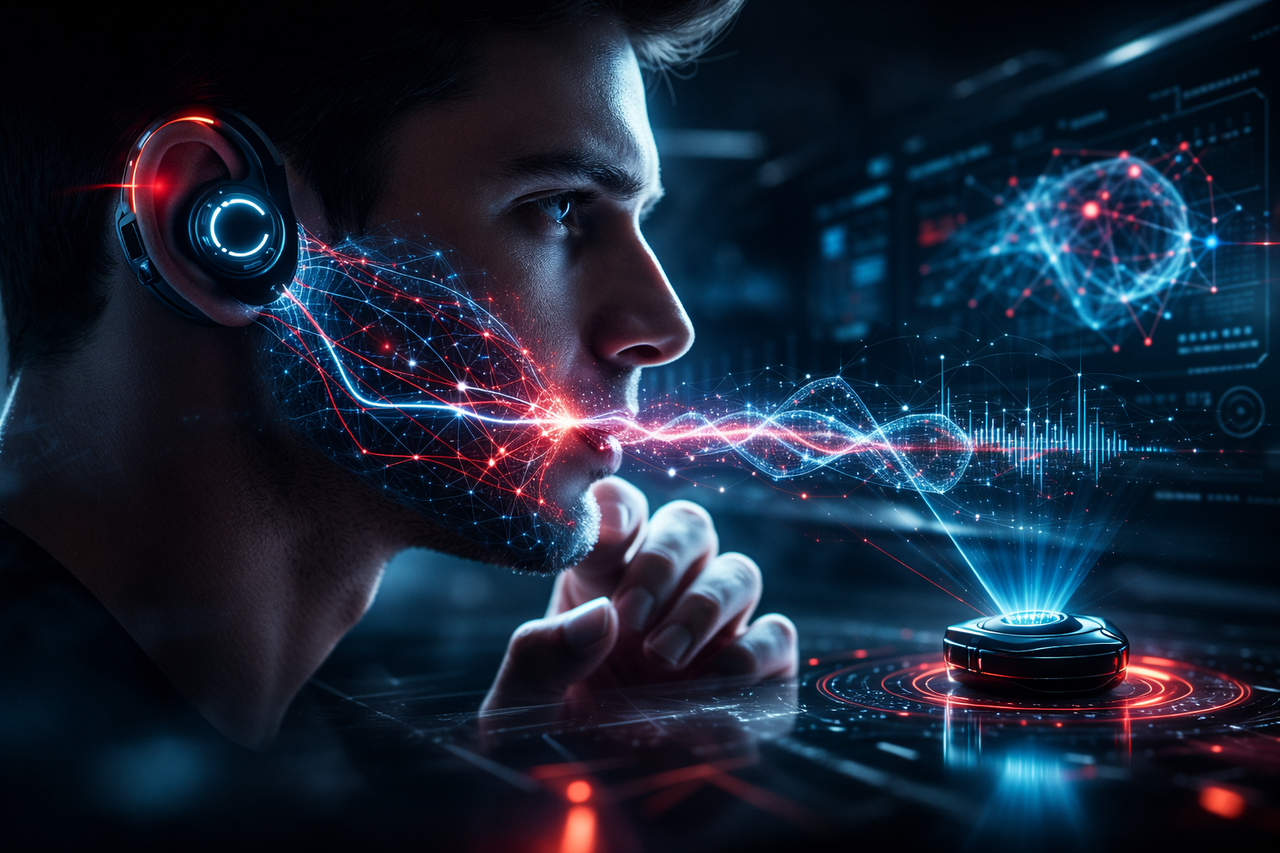
According to circulating reports, the Israeli startup has been developing a system capable of converting subtle pre-speech neuromuscular signals into digital commands or written words. Rather than reading thoughts, the system analyzes micro-movements in facial muscles that occur milliseconds before audible speech.
Using infrared-based sensors and machine learning models, the technology reportedly captures high-frequency facial signal data and translates it into structured outputs. Patent descriptions associated with the company reference a compact sensor positioned near the ear to map fine muscular activity.
Public positioning of the technology emphasizes privacy, enabling users to interact with digital assistants without speaking aloud — particularly relevant as research suggests many users avoid voice assistants in public environments.
Media reports have also noted that some of the founders previously held roles within Israeli military technology units. While no official confirmation details the nature of those roles, and no verified link connects the current product to active military applications, the background has fueled broader discussion.
Experts point out that technologies capable of detecting fine-grained physiological signals could — theoretically — extend beyond silent commands into areas such as stress detection, biometric profiling, or behavioral analysis. This raises important questions around data governance, ethical boundaries, and regulatory oversight.
International research institutions have in recent years classified human cognition tracking and neuro-interface systems among emerging strategic technologies, particularly in discussions surrounding cognitive influence and future digital conflict environments.
As of now, Apple has not released a detailed public technical statement outlining the acquisition scope or integration plans.
What appears increasingly clear is that human–machine interaction may be evolving toward interfaces that begin before speech itself.
The central question remains:
Where should the line be drawn between innovation and privacy?